Designing Secure Lockers Service
6x Revenue Growth In 6 Months
Background
This case study documents the design process for a secure and accessible locker service catering to the unique needs of urban Indians in gated communities, addressing the challenges of limited bank locker availability and increasing wealth migration.
My Role
My role involved leading the end-to-end design process, from user research and concept development to ensuring final designs go live to productions without bugs while also assisting in creating cohesive brand identity and other marketing requirements.
User Research and Concept Development
- Conducted interviews and surveys to understand potential user needs
- Analysed pain points and behaviours to identify key opportunities
- Ideated solutions based on research findings, focusing on security and accessibility
- Created user personas, journey maps, and wireframes to align with user goals
Stakeholder Collaboration
- Worked closely with cross-functional teams including marketing, product, and development
- Facilitated ideation and feedback sessions to ensure stakeholder buy-in
Delivering Final Designs
- Focused on creating design solutions that cater to user needs
- Incorporated feedback loops and iterative testing to refine solutions
Marketing Activities
- Designed the website (aurm.in) and helped other designers create illustrations
- Helped the team develop ideas and storyboard brand/demo videos
- Conducted workshops for brand identity creation and collaborations
Problem Statement
Indian households, concentrated in gated communities across major cities, face a severe shortage of secure storage solutions. Despite substantial household savings, existing bank locker options are limited, creating a gap in the market for a modern, reliable solution. Moreover, the growing trend of urban wealth migration and the desire to showcase valuables within social gatherings intensify the demand for secure, accessible storage in city centres.
Gated communities have become the choice of living for well-to-do urban households in India.
- 40% of India's population expected to urbanise by 2030
- India has 150K gated communities with 30M households and growing
- 30M families of India's elite and well-off stay in gated communities
- Physical assets contribute 60% of total household savings (gold, silver, jewellery)
- 25,000 tons of gold resides in private households in India
Bank lockers or home safes are the only current options, but neither is fully reliable. Demand for 30M lockers in top 10 cities; supply of only 3M at accessible bank branches. Only 10% of demand is being met.

Objectives and Goals
The project's primary objective was to develop a secure, accessible, and user-friendly locker service that meets the specific needs of affluent urban Indians.
The goals were to:
- Provide seamless digital onboarding and locker management experience
- Create exceptional access experience inside the access bay area
- Ensure security and privacy of users during access
- Increase user satisfaction by achieving CSAT score of 70 or higher
- Increase locker usage frequency to average of 2 visits per month
- Achieve 90% retention rate for locker subscribers within first year
Impact
The final design solution resulted in a secure and accessible locker service. Post-launch after 6 months, the service has achieved significant success, exceeding initial goals. Key metrics demonstrate its impact:
- User Acquisition & Engagement: 95% onboarding completion rate; average locker usage frequency increased from 0.5 to 2.2 visits per month per user after 6 months
- Error/Fatality Rate: 30% in month 1, decreased to 5% in 6 months
- Revenue Growth: Month 1: ₹2,72,141 → Month 6: ₹59,60,502
- User Satisfaction: CSAT and NPS scores exceeding 75
- Security & Compliance: Low security incident rate; 100% compliance audit success rate
Research and Insights
We conducted in-depth research to understand user needs, challenges, and preferences. The research methods included:
User Interviews
We conducted interviews with homeowners, digital banking users, and first-time locker subscribers to gather qualitative insights on their pain points, priorities, and expectations for a secure storage solution.
Participants: Around 10-15 individuals from each target persona group
Surveys
We collected quantitative data to validate insights, specifically on locker demand, usage patterns, and feature preferences.
Sample Size: Expected 500-600 responses; received over 350 responses from Bengaluru gated community residents
Competitive Analysis
We also assessed the strengths, weaknesses, and unique offerings of competing locker and storage solutions to benchmark and innovate.
Competitors: Major banks (HDFC, SBI, ICICI, AXIS), private locker services
Key Takeaways from Research
User Needs and Demand
- Over 60% of urban residents show interest in secure locker services, with high demand from first-time subscribers
- Users prioritize storing valuables like jewelry and documents, seeking reliable, secure options
- Most need flexible, on-demand access for occasional use, such as parties or storing documents
Access and Security Preferences
- 50% prefer digital access (QR codes, biometrics), showing interest in modern, hassle-free options
- Mobile/app-based features like access history and joint access are highly favored for convenience
- Security is key, with 70% valuing features that boost confidence and peace of mind
Pain with Current Solutions
- Long bank wait times (6+ months) drive users to seek alternatives
- Multiple ID checks and in-person visits deter users looking for convenience
- Lack of digital functionality in banks leaves a gap for tech-enabled solutions
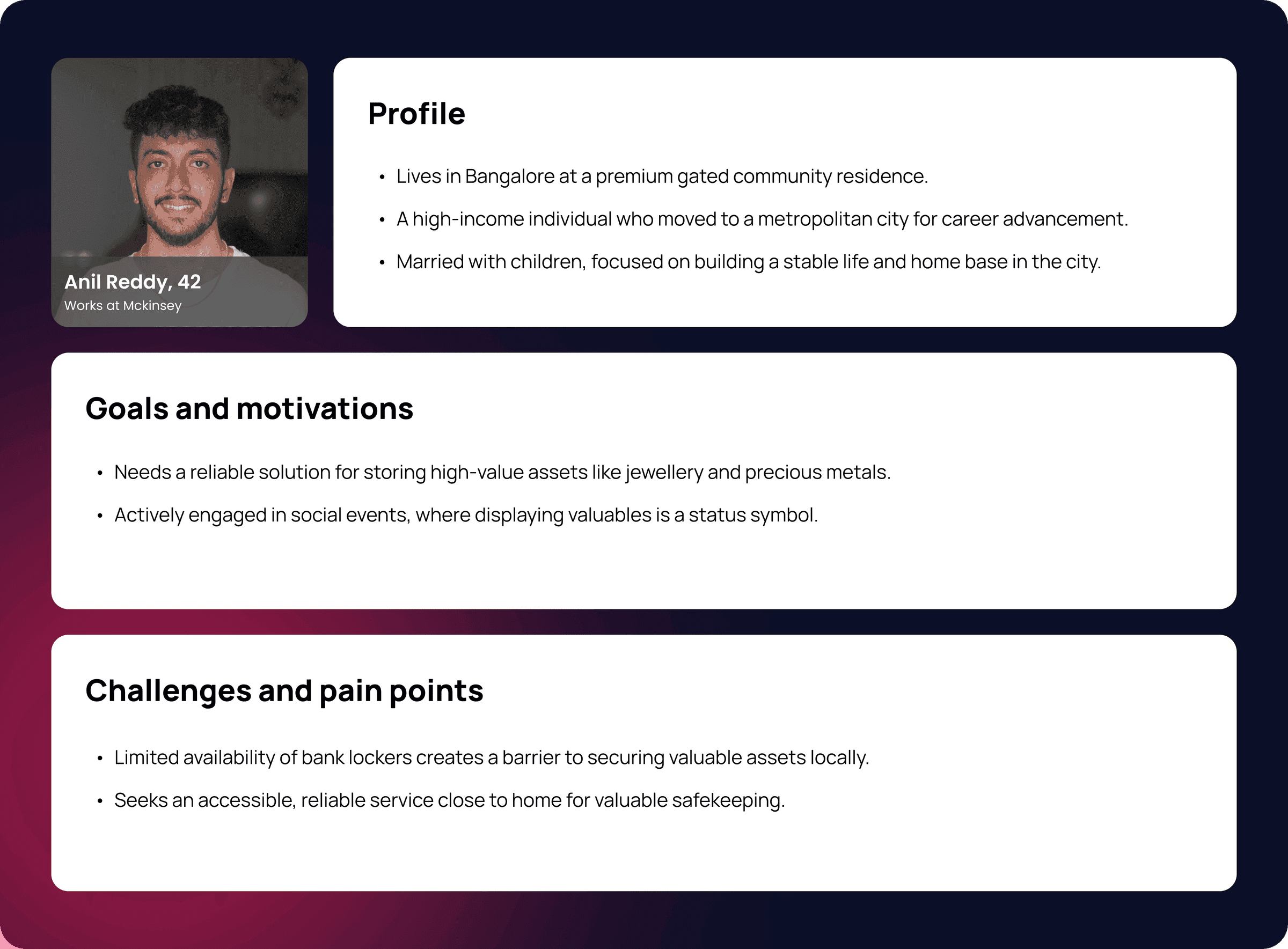
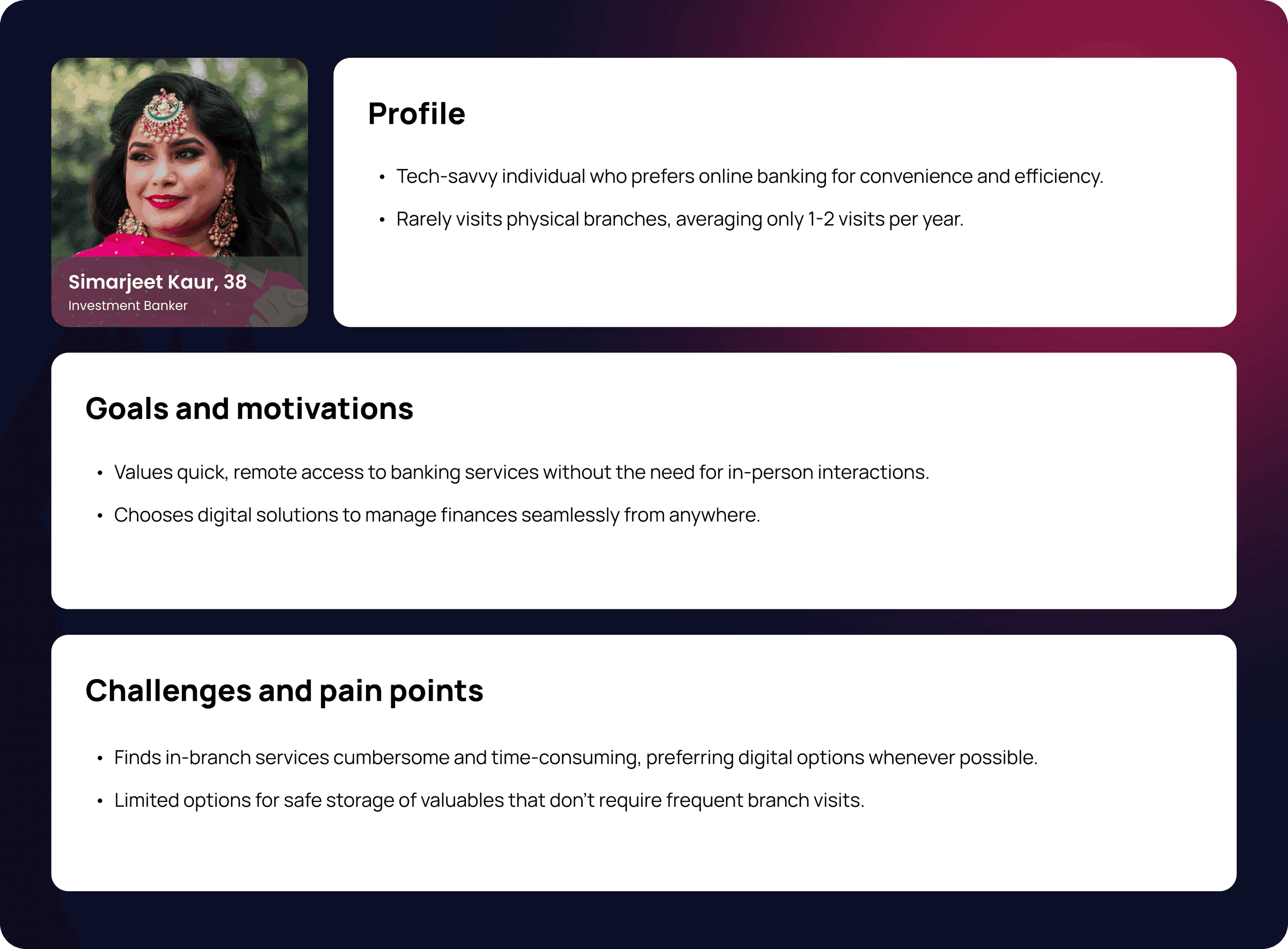
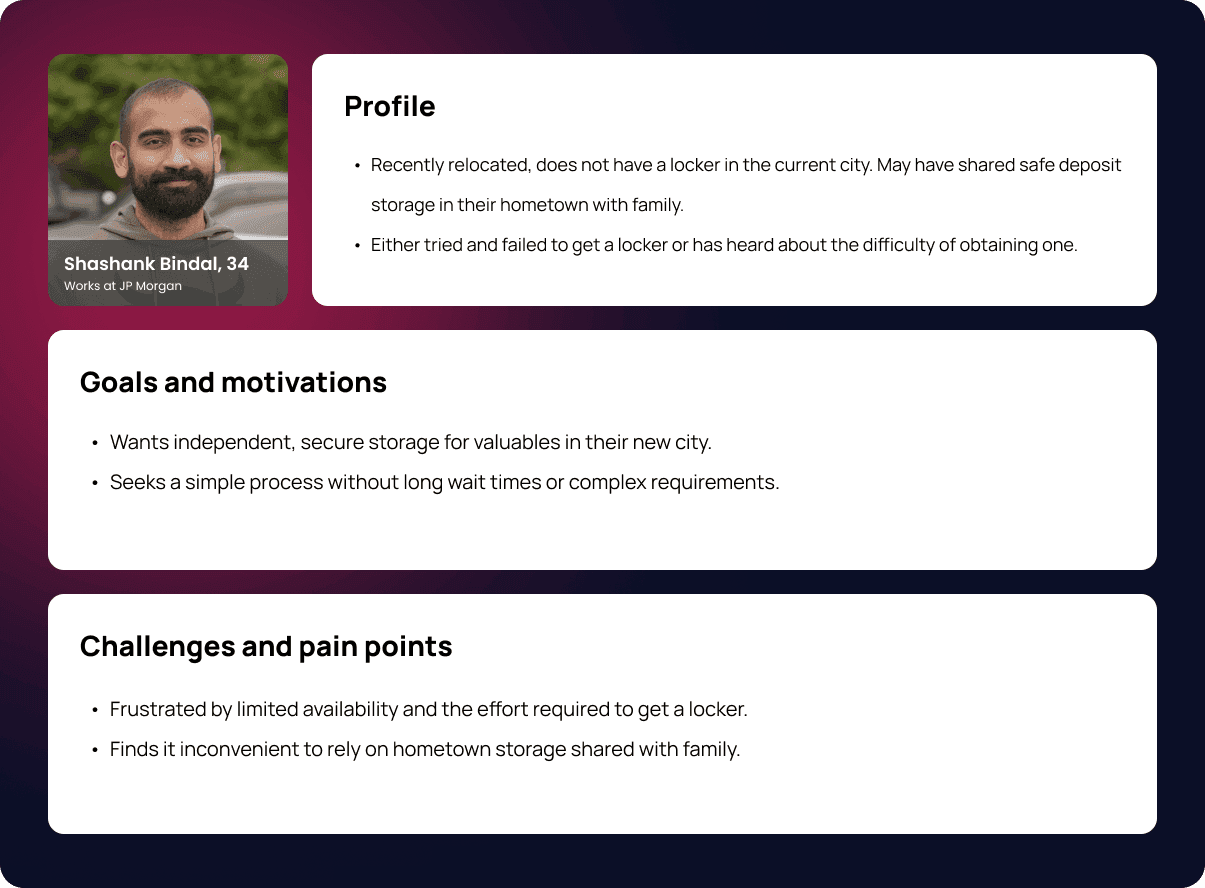
User Personas
We mapped out user personas to better understand the problems from a user perspective.
Design Stage
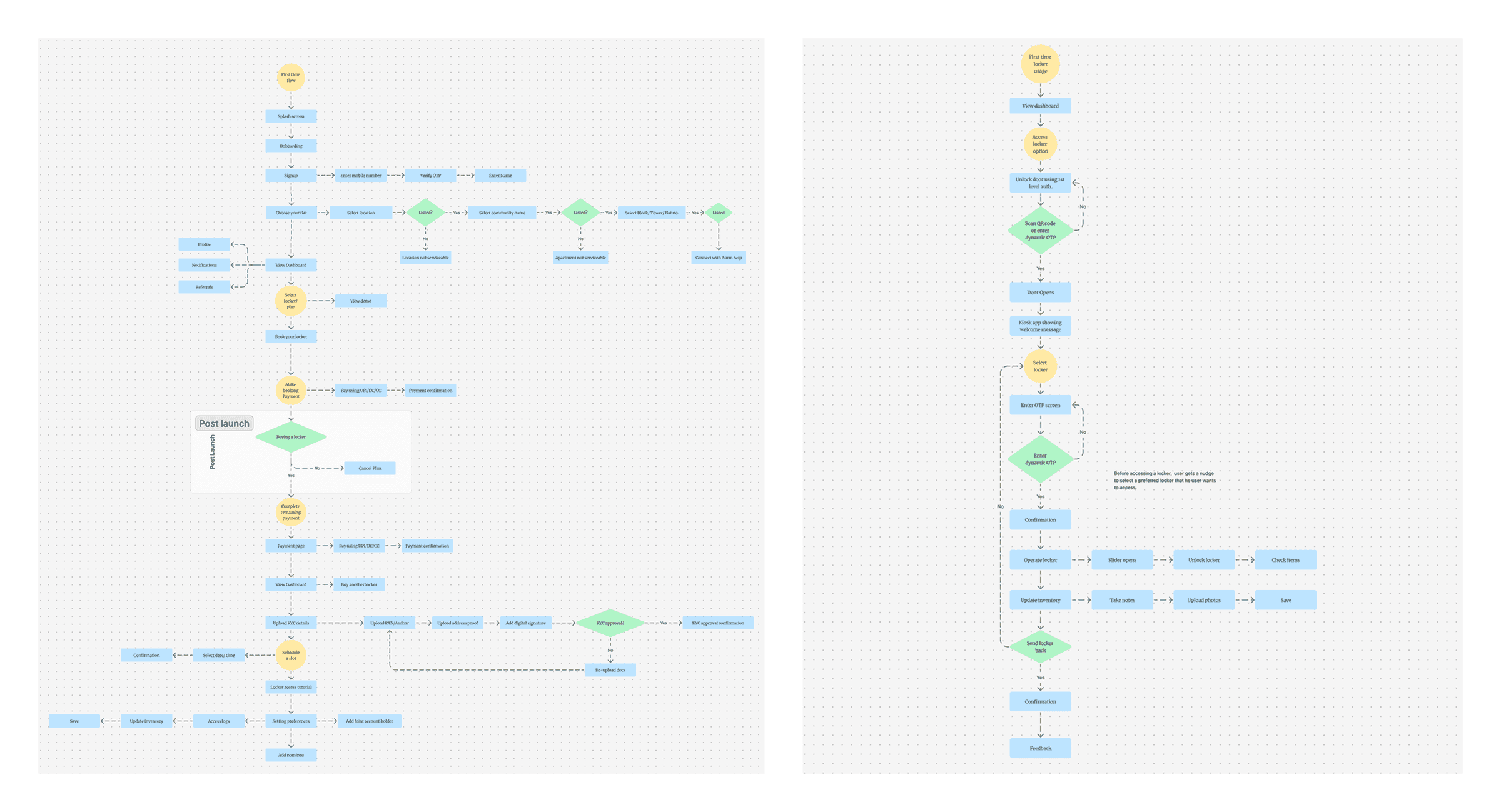
User Flows
We created user flows for onboarding phase and access phase. This was done to ensure everyone in the team gets an idea about the how will user traverse will accessing the product.
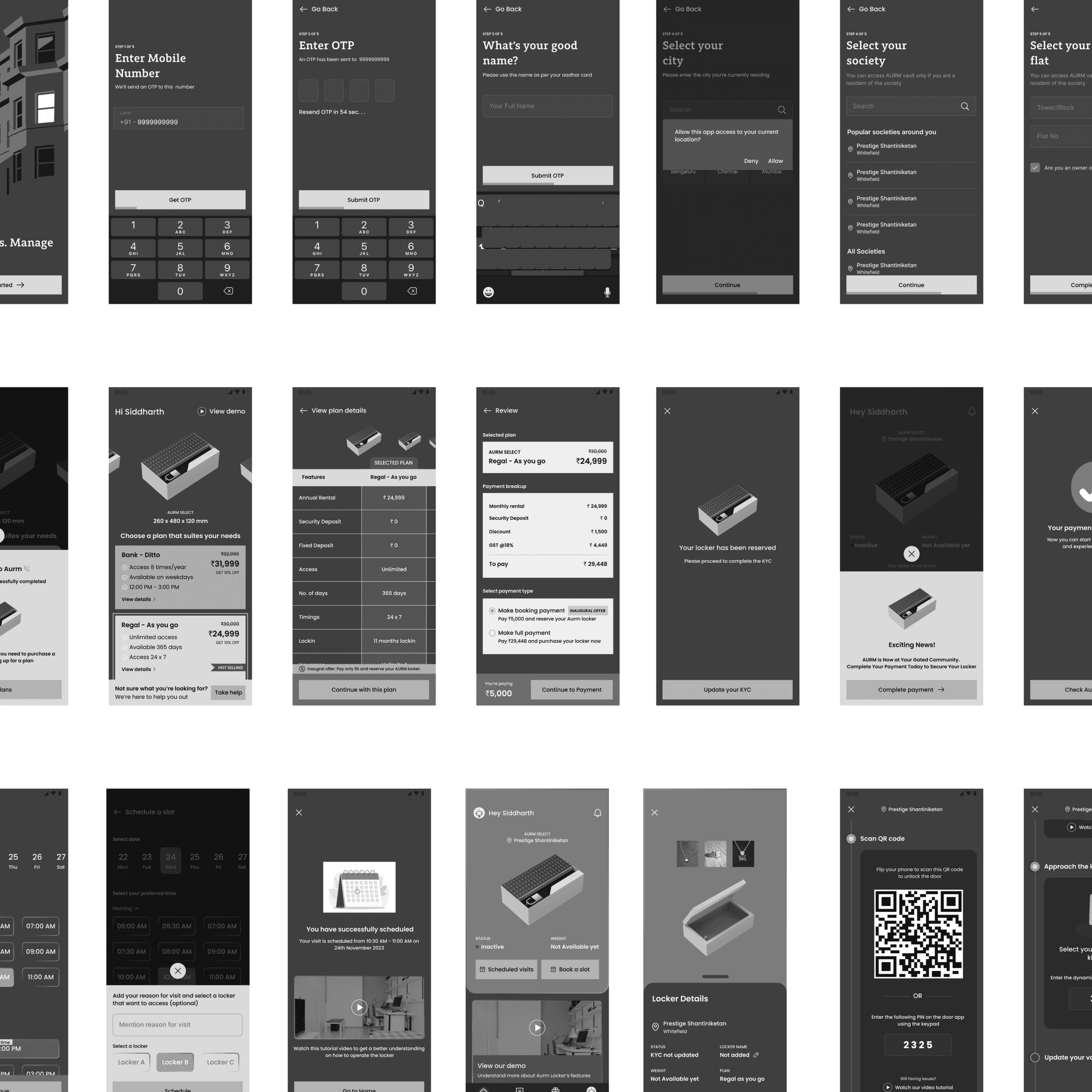
Wireframes
We worked on the wireframes and showcased it to our internal team. After multiple rounds of iteration we then showcased it to the users who were part during our research stage. This was to give a brief idea about how the app would function and also to get their feedback on the whole experience.
Visual Designs
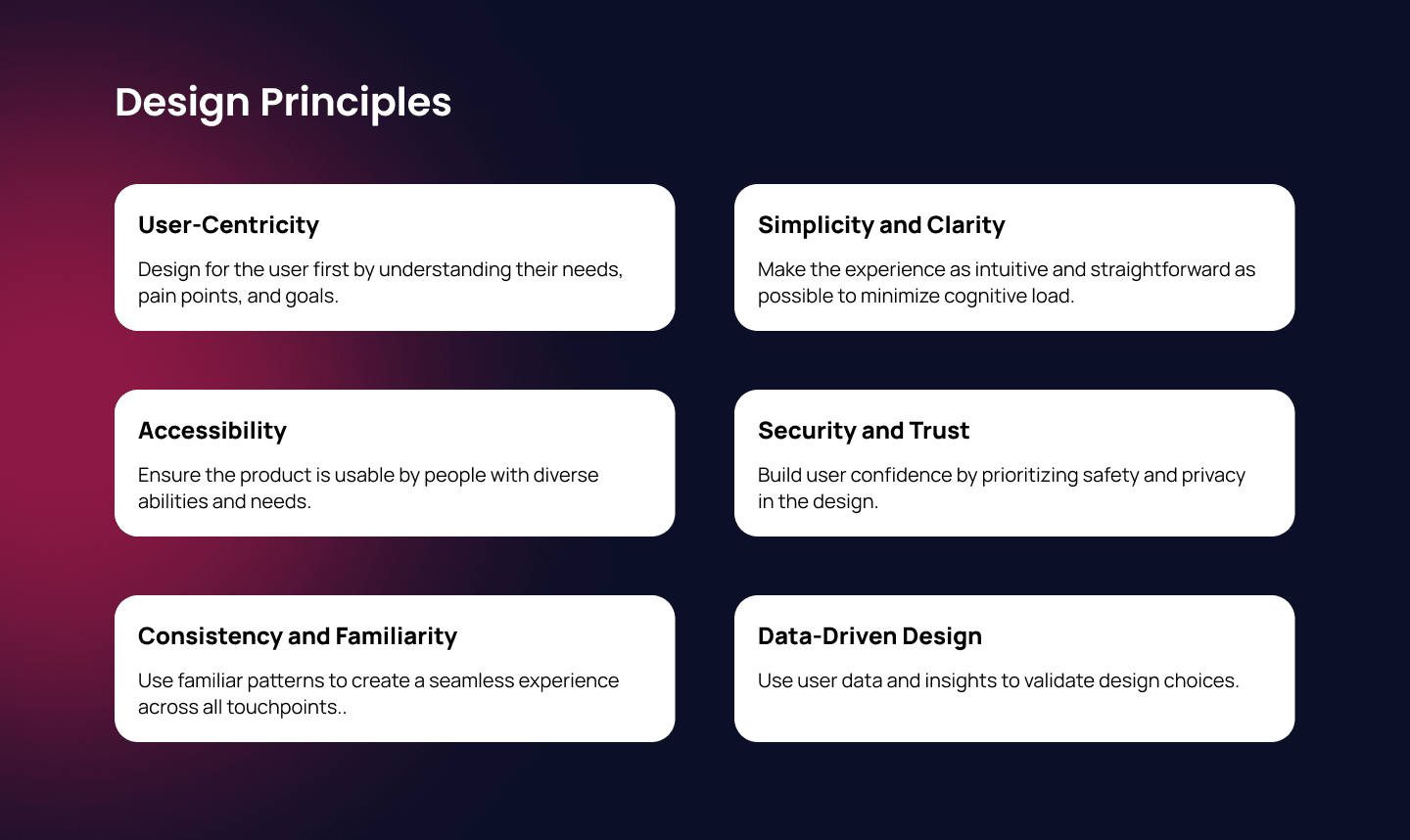
Some of the design principles that we considered while executing the designs
Interaction Design
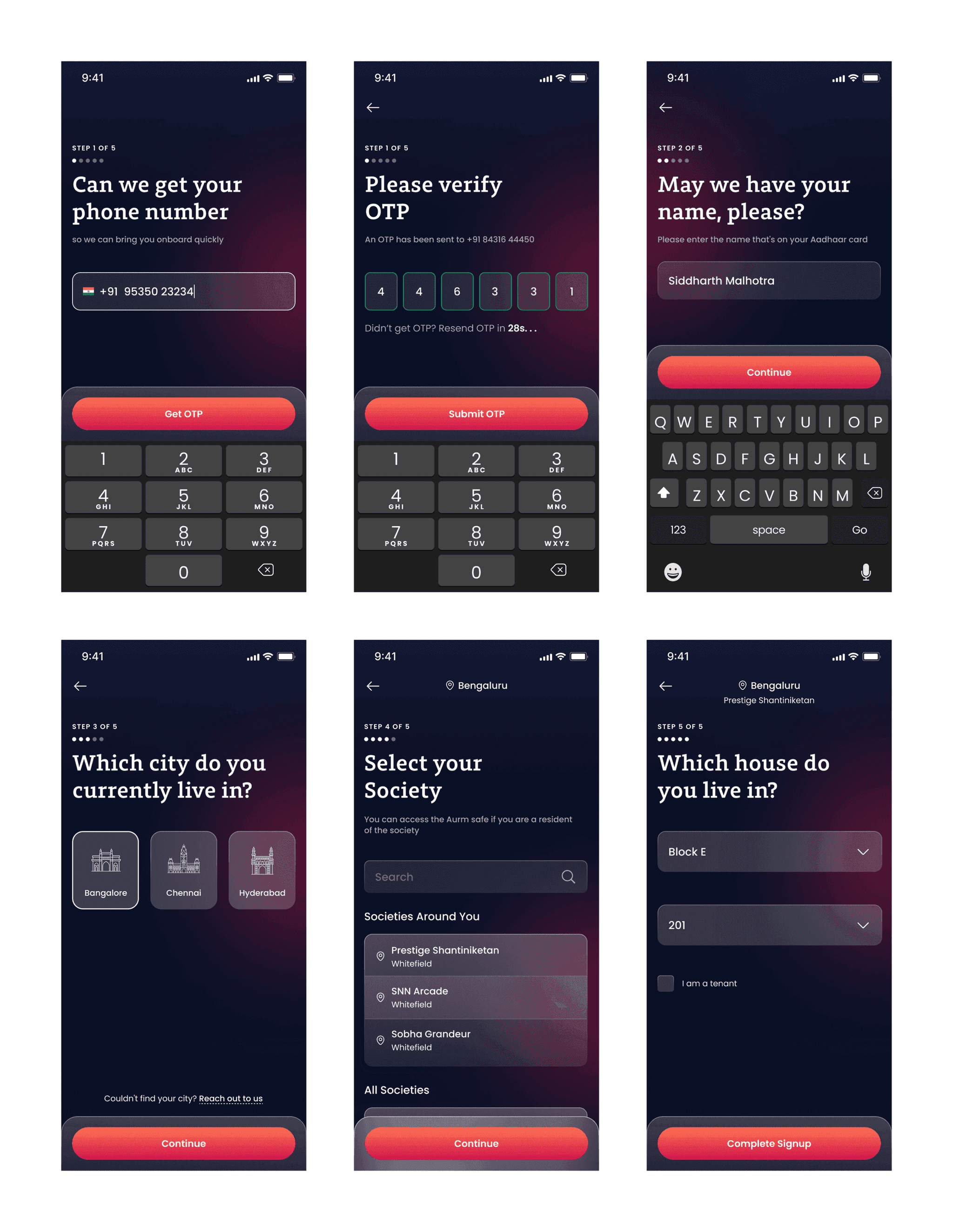
Onboarding
The idea was to capture the details that are just relevant for the user to proceed further and not make it too long and cumbersome.
Intro Screens
Users are presented with a welcome screen and next set of steps to complete the whole process.
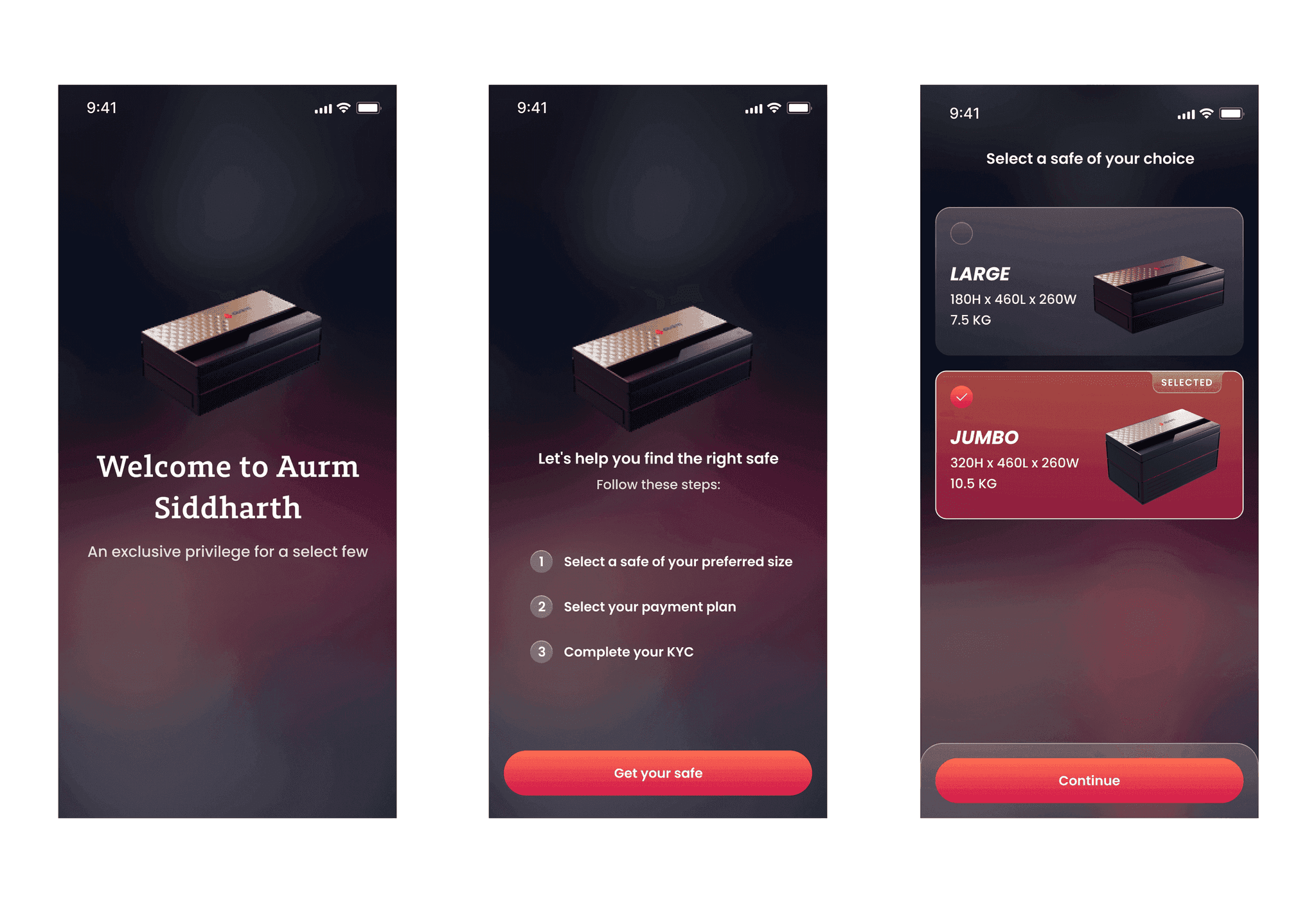
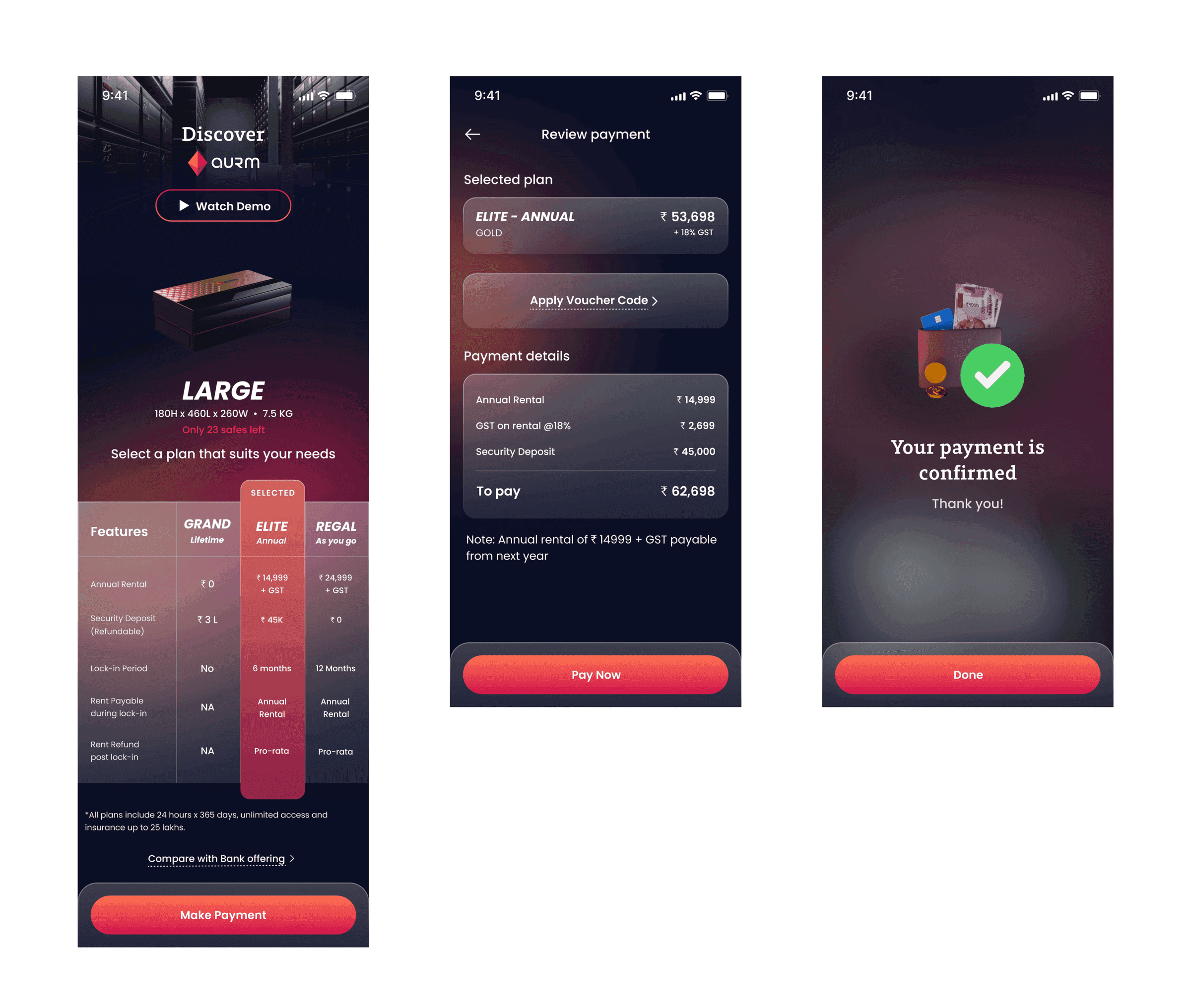
Select Locker/Plan and Pay
At this step, a user would typically select a locker of his/her choice and choose a plan against it and after confirmation of their selection they would move to payment and confirm their locker purchase.
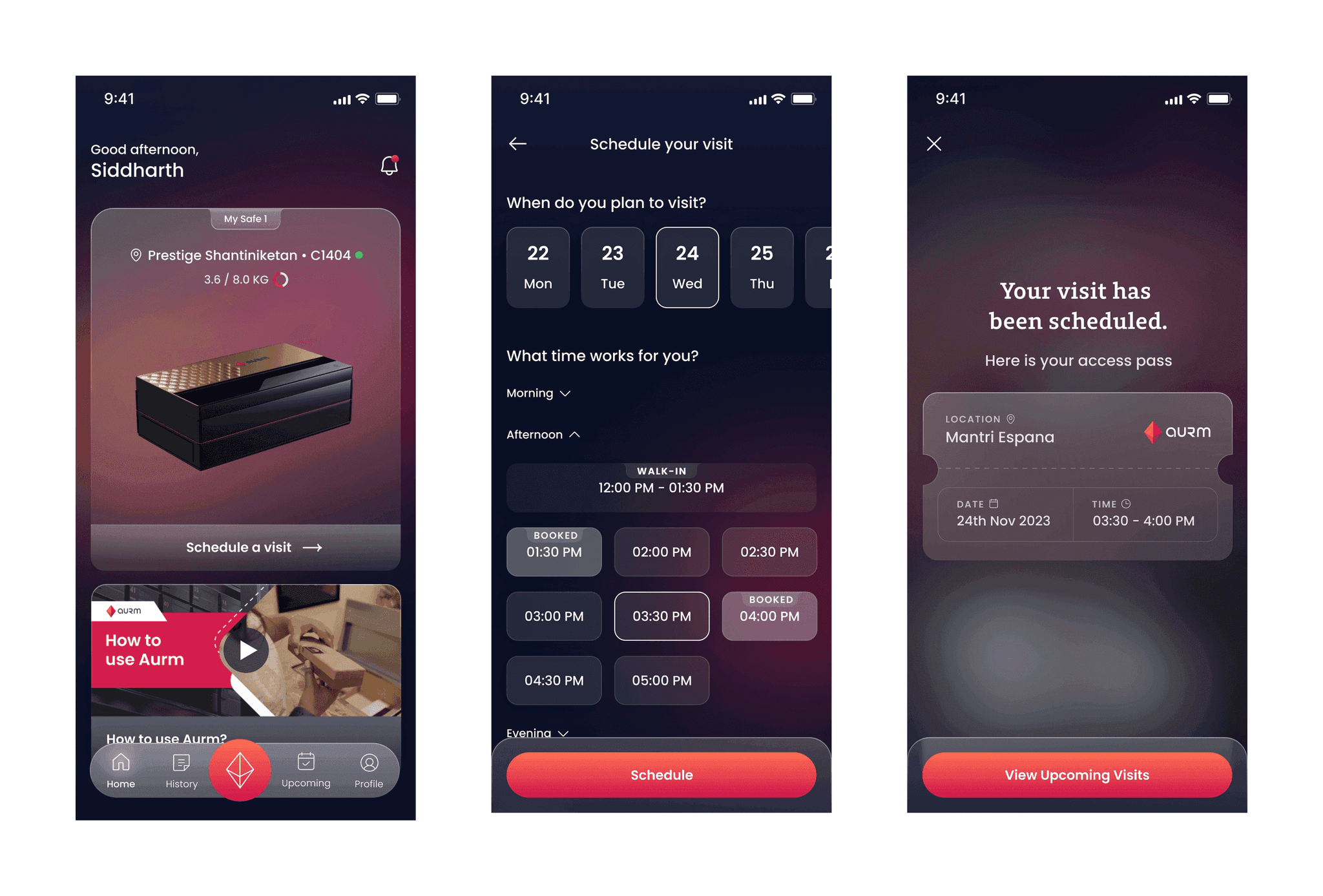
Easy Scheduling
After assignment of locker user can either or walk-in or schedule a slot based on their availability. This gives more flexibility to the users to operate based on their convenience.
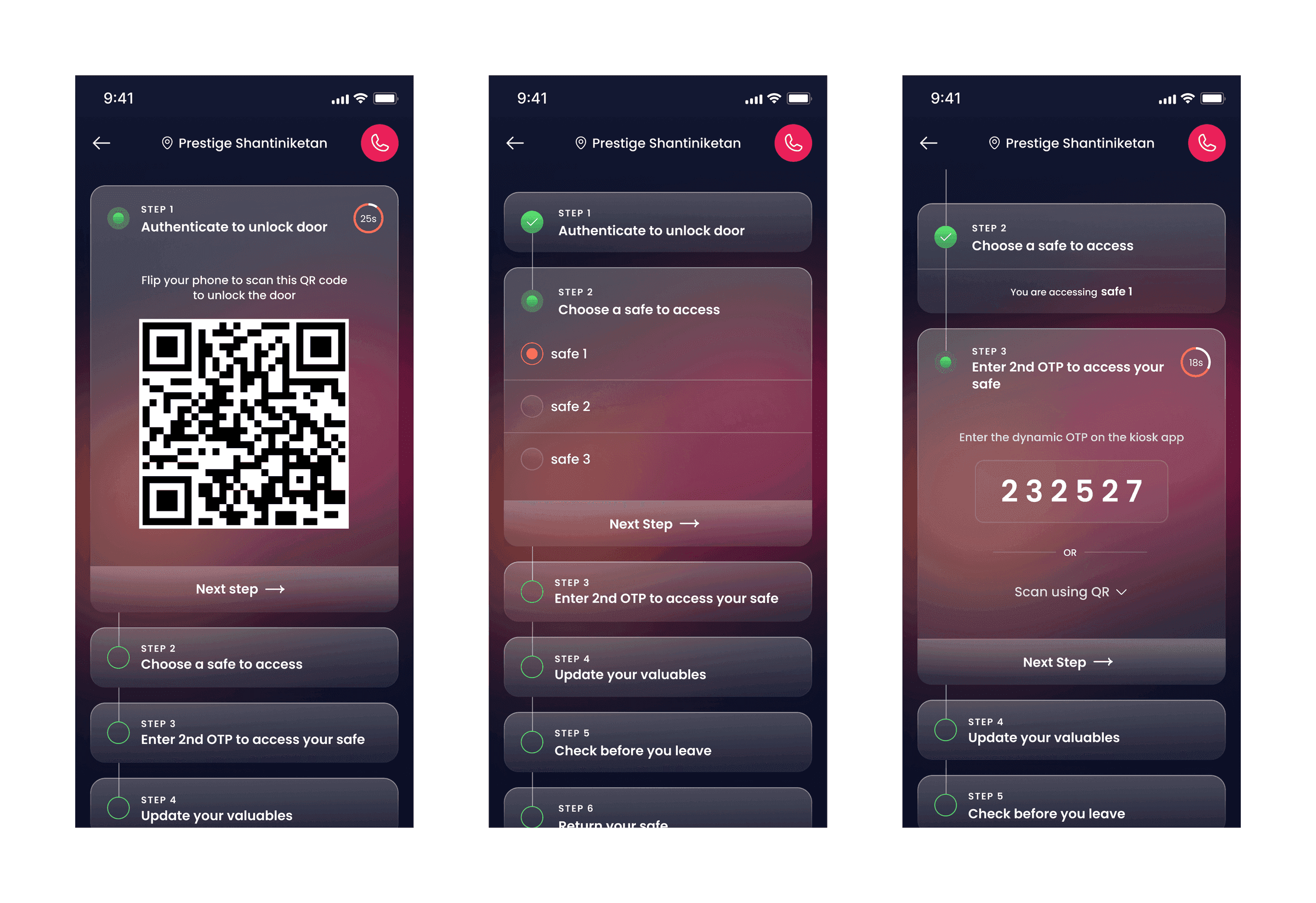
Access
We added an extra layer of security for the users by adding two levels of authentication. One at the door (QR Scan) and one while fetching the locker (OTP) to ensure that security isn't put under threat.
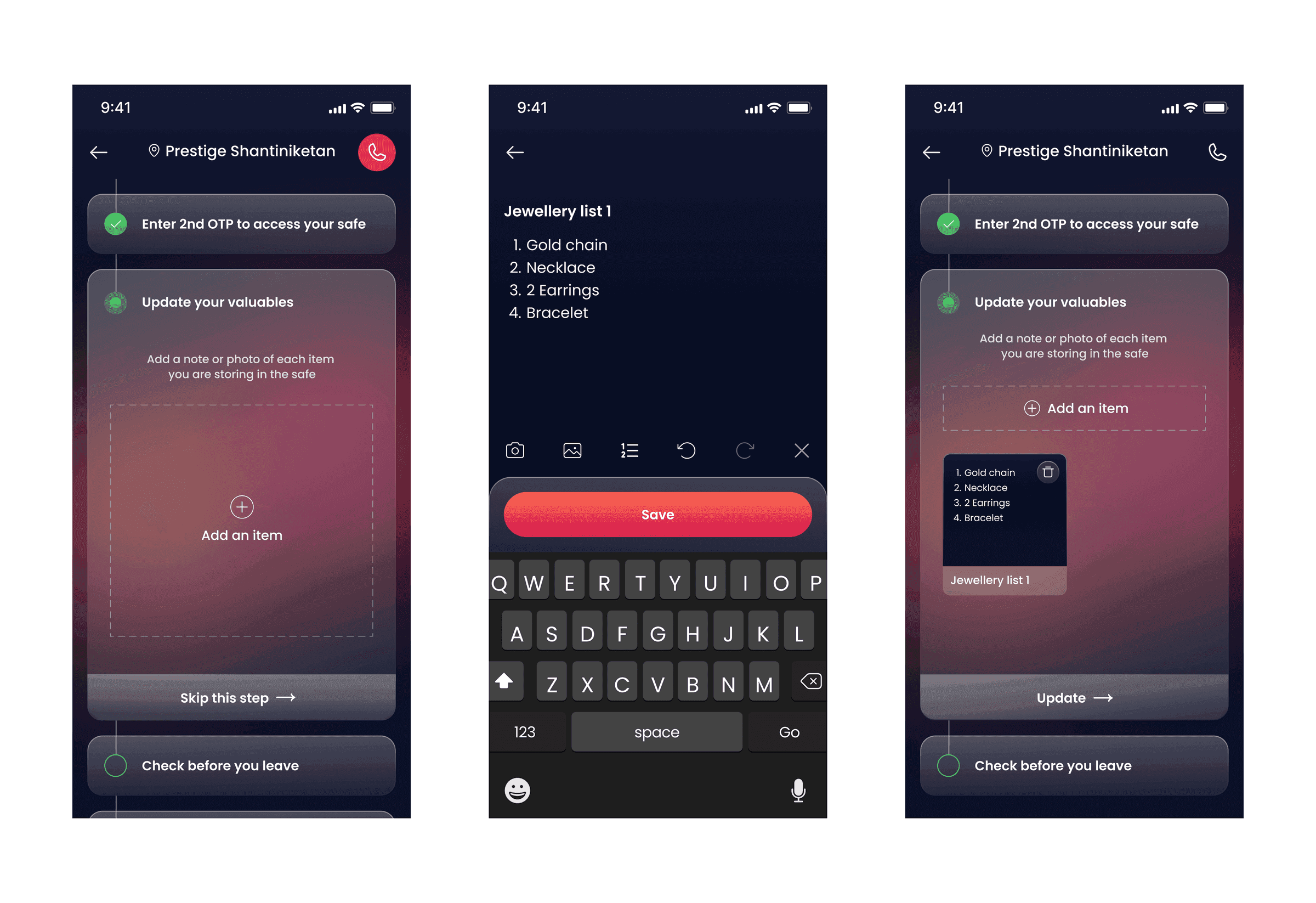
Inventory
While the user access the locker, putting valuables or taking them out they can also take a snap or create of list of all the valuables updated. This allows the users to keep a track of all the valuables access thereby creating transparency.
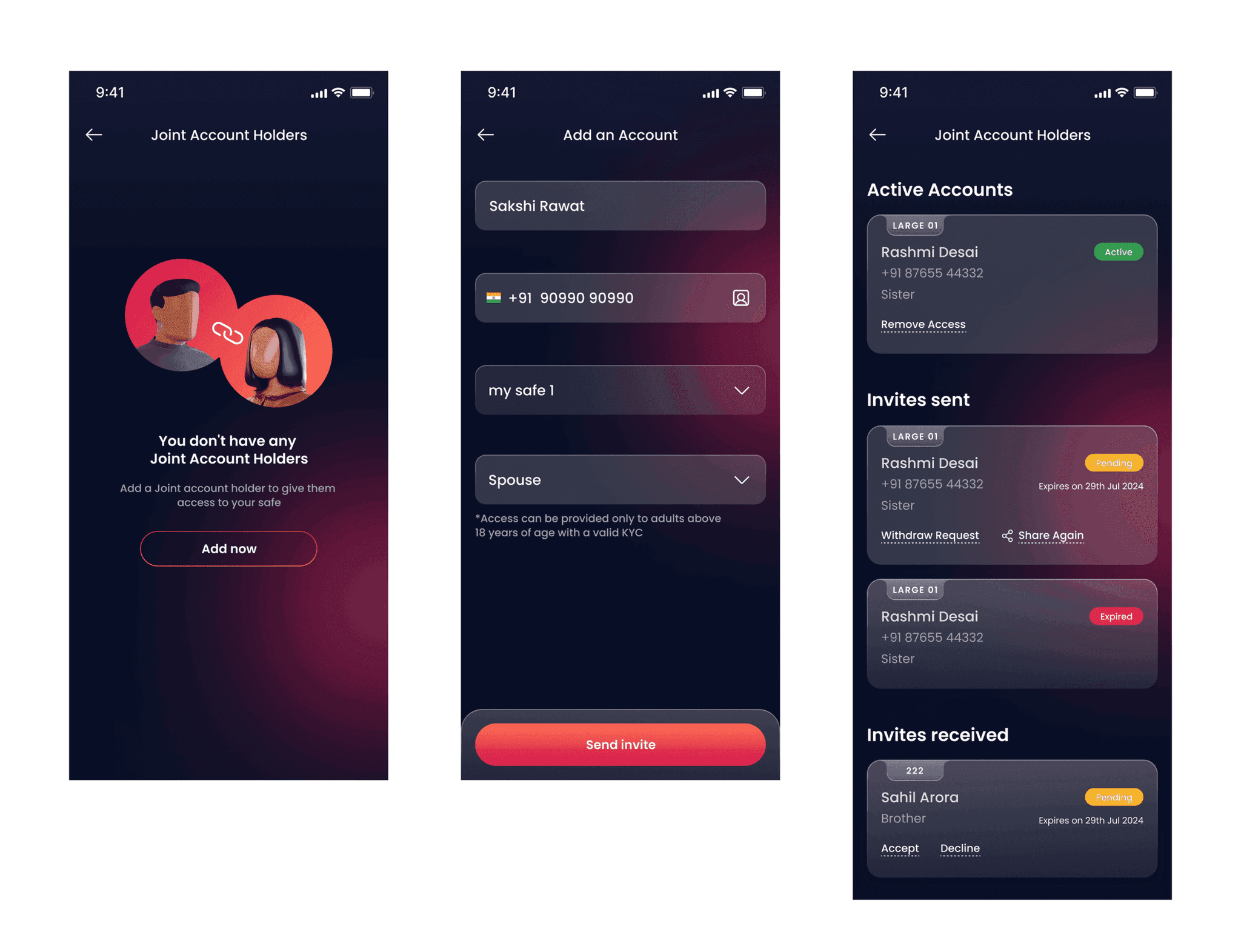
Joint Account Access
Users can give access of lockers to their family members and closed ones. This feature gives a flexibility to everyone using the same locker and keeps everyone updated about the access and valuables stored.
Demo Access Video
How our users can access their lockers inside the Bay Area. It also showcases the interior and various elements kept inside for an enhanced experience.
Challenges and Solutions
Several challenges were encountered during the project:
- Building trust and overcoming security concerns: Communication regarding security protocols, compliance standards, and real-time notifications built user trust and transparency
- Advance payment issue: Users were uncertain about making two payments (before and post-launch). They believed one advance payment would suffice and were difficult to re-engage for post-launch payment
- Payment integration: Team switched between multiple payment partners due to high failure rates during user transactions
- Automating KYC verification: Third-party KYC collection required manual intervention and took 48 hours for locker assignment. Moved to automated verification system for faster assignment
- Integrating and testing new technologies: Encountered failures in OTP authentication and mobile QR access. Conducted rigorous testing; explored alternatives like Bluetooth and palm recognition
- Compliance and regulatory challenges: Strict regulations for safe deposit lockers (data privacy, anti-theft, banking regulations) required close collaboration with legal and compliance teams
- Anxiety while waiting for the locker: Users experienced anxiety during the ~1-minute robot retrieval time. Implemented messaging showing locker location and added educational videos about app features
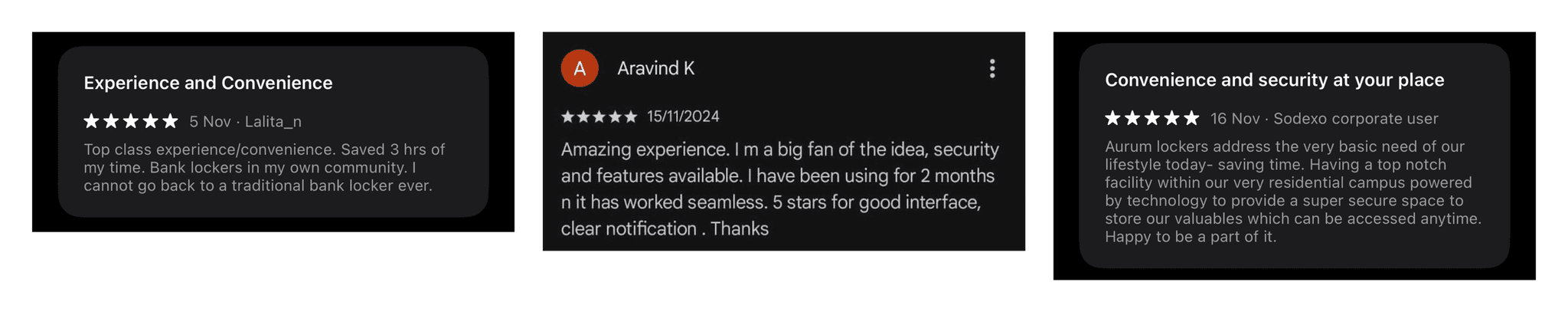
Rating and Feedback
We received positive feedback from our users and they got really excited when the locker actually popped up in the access bay area during our demos. They also highlighted what could be improved and at exactly what point they were facing any issue.
Learnings and Reflections
This project provided valuable insights into the design process, particularly for digital services catering to diverse user needs.
- Building Trust: Establishing trust through transparency, clear communication, and robust security measures is critical for digital service success
- Iterative Design: The iterative process allowed continuous improvement based on user feedback, leading to more effective, user-centric solutions
- Balancing Security and Convenience: Finding balance between security features and user-friendliness was crucial, requiring thoughtful security design and access protocols
- Operational Efficiency: Automating processes and integrating new technologies were essential for ensuring scalability and operational efficiency
Conclusion
The successful design and implementation of Aurm Locker Service have not only solved the problem of limited locker availability but also established a new standard for secure, accessible storage solutions in Bengaluru's landscape. The service has empowered urban residents with a convenient and trustworthy option to safeguard their valuable assets.
Future plans for the project include expanding locker availability to additional cities, introducing new features like insurance on valuables, and exploring partnerships with financial institutions.